Home Spa & Wellness Room Design Ideas
Insights and Ideas
June 29, 2026
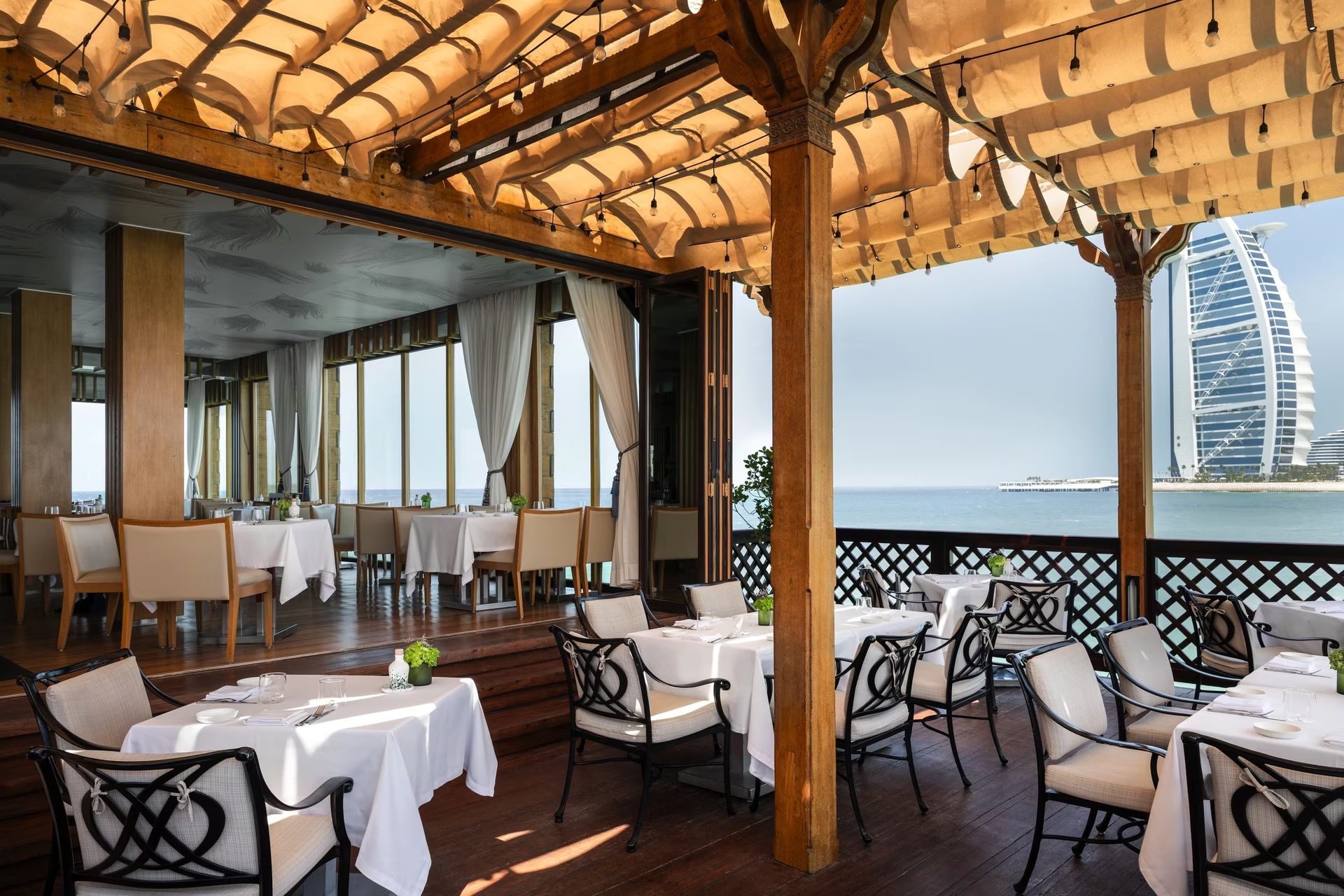

There are plenty of beautiful restaurants in Dubai, but Pierchic Dubai sits in a category of its own because the experience begins long before the first plate arrives. You do not simply walk into a dining room from a lobby or a mall corridor. You approach it across a private pier, with water around you, the skyline behind you, and the Arabian Gulf setting the mood before the interiors even have a chance to speak. That arrival sequence is part of the design. It slows people down. It gives the restaurant a sense of theatre without needing to shout. According to Jumeirah, Pierchic is located on a private pier at Jumeirah Al Qasr and offers an Italian fine dining experience in a beachside setting with scenic views.


What makes Pierchic interior design interesting is that it does not rely only on furniture, lighting, or decorative styling. The restaurant uses setting as a design material. Water, distance, reflection, horizon, and silence become part of the room. That is why the space feels romantic without being overly sentimental, luxurious without feeling heavy, and exclusive without becoming intimidating. Many Dubai restaurants try to impress with height, gold, mirrors, or dramatic chandeliers. Pierchic takes another route. It creates drama by stepping away from the city and placing the guest almost inside the landscape. The result is a dining space where the Arabian Gulf view is not a backdrop, it is the main character.
The walk to Pierchic is one of its strongest design moments. A pier naturally creates anticipation because it stretches time. You see the restaurant before you reach it, and every step builds a little more curiosity. In interior design, this is known as sequencing, where the journey toward a space becomes part of the emotional experience. Pierchic uses that idea beautifully. Instead of giving guests instant access, it makes them cross a threshold from land to water, from resort energy to calm, from ordinary evening to occasion. The Michelin Guide describes Pierchic as sitting at the end of its own pier, with water beneath and views of the Burj Al Arab.
That arrival also changes the psychology of the meal. By the time guests reach the entrance, they have already detached from the noise of Dubai. The city is still there, but it feels softened, almost edited out. This is where Pierchic’s design becomes smart. It does not need to over-decorate the entrance because the walk itself has already done the emotional work. The restaurant feels like a destination rather than a venue. For designers, this is a useful lesson: the strongest luxury experiences often begin before the guest crosses the door. A corridor, driveway, bridge, garden path, or pier can do more for mood than an expensive feature wall ever could.
Once inside, Pierchic continues the idea of being surrounded by water. The experience is not just “sea view dining” in the usual sense. It feels more immersive because the restaurant is physically positioned over the Gulf. Visit Dubai describes Pierchic as an over-the-water dining experience overlooking the Burj Al Arab in Jumeirah. That distinction matters. A beachfront restaurant looks toward the water. An overwater restaurant makes the water part of the architecture. The dining room becomes a kind of floating pavilion, where the edges of the interior blur with the horizon outside.
This overwater setting changes the role of interior design. In a normal restaurant, designers often create atmosphere through layers: artwork, textures, lighting, upholstery, ceiling details, and decorative objects. At Pierchic, the outside world already carries so much visual weight that the interior must know when to step back. Too much pattern or visual noise would compete with the Gulf. Too little detail would make the space feel unfinished. The balance lies in creating enough refinement for fine dining while allowing the view to breathe. This is what gives Pierchic its understated elegance. It understands that when your dining room is above the Arabian Gulf, restraint is not a weakness. It is the whole point.
Pierchic cannot be understood properly without looking at its wider setting. It belongs to the world of Jumeirah Al Qasr, one of Dubai’s most recognisable resort environments. Jumeirah describes Al Qasr as a majestic Arabian setting within Madinat Jumeirah, with meandering waterways, palms, views of the Arabian Gulf, and views of Jumeirah Burj Al Arab. This matters because Pierchic’s interior identity is not floating in isolation. It is part of a larger design story built around Arabian hospitality, coastal luxury, and resort escapism.
Madinat Jumeirah itself is designed like a modern interpretation of an Arabian resort town. The waterways, bridges, palms, souk-style spaces, and layered architecture all create a sense of movement and discovery. Pierchic benefits from this because the guest is already inside a highly designed environment before arriving at the restaurant. The resort sets the cultural and architectural tone, while Pierchic shifts the mood into something more serene and marine. This contrast is important. Al Qasr gives grandeur. Pierchic gives release. Al Qasr feels palatial and grounded. Pierchic feels light, open, and suspended. Together, they create one of Dubai’s most memorable hospitality transitions.
Jumeirah Al Qasr gives Pierchic a strong architectural parent. Visit Dubai notes that Al Qasr is designed in the style of a palatial residence, reflecting traditional royal architecture with modern flair. That means guests often move from an environment of arches, symmetry, rich surfaces, and Arabian-inspired grandeur into the softer, more open world of Pierchic. This contrast makes the restaurant feel even more special. It is not trying to repeat the palace language exactly. It responds to it by becoming lighter, more coastal, and more intimate.
This is one of the cleverest things about Pierchic from an interior design perspective. It does not ignore its context, but it also does not copy it. A weaker concept might have overloaded the restaurant with obvious Arabian motifs, lanterns, carved screens, heavy patterns, and gold accents. Pierchic’s strength lies in translation rather than imitation. The Arabian Gulf, the Burj Al Arab view, and the resort’s palatial setting are all acknowledged through mood, framing, and atmosphere rather than theme-park decoration. This is why the restaurant still feels refined. It borrows from place, but it does not become a cliché of place.
Madinat Jumeirah’s waterways are more than a pretty resort feature. They form part of the visual rhythm that prepares guests for Pierchic. Jumeirah describes Madinat Jumeirah as a regal setting on Dubai’s golden shoreline, with picturesque waterways, palms, Arabian Gulf views, and Burj Al Arab views. By the time guests reach the restaurant, they have already experienced water as a recurring design element. The canals, abra rides, reflections, and shaded walkways create a sense of old-world leisure, even though the entire environment is carefully designed for modern luxury.
Pierchic then takes that water narrative and pushes it further. The guest moves from water beside them to water below them. That shift is subtle but powerful. It turns a resort feature into a full sensory experience. You do not just see water, you feel separated by it. You hear it, sense its movement, and watch the light change across it. This is why the restaurant is so often described as romantic. Romance here does not come only from candles or table settings. It comes from being slightly removed from the mainland, held between architecture and sea. Good hospitality design often works like this. It takes one idea and lets it build slowly across the journey.
The main aesthetic of Pierchic Dubai interior design can be described as coastal fine dining with a restrained luxury approach. It is not rustic beach design, and it is not flashy Dubai glamour either. It sits somewhere more delicate: polished enough for special occasions, but soft enough to let the natural surroundings lead. The space feels clean, elegant, and view-focused. This makes sense because a restaurant in this location should never behave like a closed box. The interior needs to open outward, creating a relationship between table, guest, glass, water, and skyline.
The design works because it understands hierarchy. In a room like this, the view must come first. The furniture, lighting, tableware, flooring, and ceiling details should support that experience, not fight it. This is where many waterfront restaurants get it wrong. They fill the space with too many nautical symbols, oversized décor pieces, or loud colours, then wonder why the view feels secondary. Pierchic avoids that trap by keeping the atmosphere composed. It feels designed, but not desperate to prove it. That kind of confidence is very Dubai, but in a quieter and more mature way.
Light is one of the most important elements in Pierchic’s design. During the day, natural light reflects off the Arabian Gulf and fills the restaurant with a clean coastal brightness. At sunset, the atmosphere warms and softens. At night, the windows become dark mirrors, the Burj Al Arab glows in the distance, and the interior lighting takes on a more intimate role. This changing light means the same restaurant can feel different across lunch, sunset, and dinner. Jumeirah lists Pierchic for lunch, brunch, and dinner, which means the space needs to perform across very different lighting conditions.
Glass also plays a central role because it allows the restaurant to maintain visual contact with the Gulf. In waterfront dining, windows are not just functional openings. They are frames. They decide what the guest sees, how much horizon enters the room, and whether the view feels cinematic or casual. Pierchic benefits from the simple luxury of openness. The more the restaurant allows guests to look outward, the more memorable the meal becomes. This is why the interior does not need to rely on loud decorative gestures. The glass, light, and water already provide movement, depth, and drama.
At Pierchic, the view is not something outside the design. It is part of the design. This is a key idea for anyone studying restaurant interior design in Dubai. The best interiors do not stop at the walls. They borrow from what surrounds them. In Pierchic’s case, the Arabian Gulf, the Burj Al Arab, the coastline, and the open sky all become part of the dining room’s composition. The Michelin Guide specifically highlights the water beneath and Burj Al Arab views as defining features of the restaurant experience.
This creates a layered visual experience. The table is the closest layer. The interior finishes form the second layer. The glass edge creates the third layer. Then comes the sea, the horizon, and the landmark view. A guest may not consciously analyse all of this, but they feel it. They sense that the room has depth. They feel that there is something beyond the plate, beyond the table, beyond the occasion. That is one reason Pierchic photographs so well, but more importantly, it is why the restaurant stays in memory. Strong design does not just look good in images. It gives people a feeling they can recall later.
Pierchic’s material and colour story is best understood through its setting. A restaurant above the Arabian Gulf should feel connected to water, light, and air, but it also has to maintain the polish expected from fine dining. This is where soft luxury becomes important. Instead of relying on aggressive shine, heavy ornament, or overly themed marine styling, the design mood leans toward refinement. The ideal palette for a space like this naturally includes sea-influenced tones, soft neutrals, warm metallic touches, glass, polished surfaces, and tactile upholstery that feels comfortable without becoming casual.
The emotional tone is just as important as the physical palette. Pierchic is often associated with romance, celebrations, proposals, anniversaries, and destination dining. Jumeirah categorises the restaurant with fine dining, romantic ambiance, signature dining, scenic views, and beachside dining. The interior has to support all of these expectations at once. It must be special enough for a milestone dinner, comfortable enough for a long meal, and calm enough to let conversation happen naturally. That is a difficult balance. Too formal, and it becomes stiff. Too relaxed, and it loses occasion. Pierchic sits in the middle, which is exactly where memorable luxury often lives.
The most logical colour inspiration for Pierchic is the Arabian Gulf itself. Think pale sand, warm ivory, muted blues, soft greys, pearl tones, and evening shadows. These colours work because they do not interrupt the view. They echo it. A strong coastal interior does not need to paint everything blue or hang seashell artwork on the wall. That approach can quickly feel predictable. A more sophisticated way is to take the emotional temperature of the coast and translate it through materials, lighting, and contrast. Pierchic’s setting naturally encourages this softer reading of coastal design.
This kind of palette also works well in Dubai because the city’s light is strong. Harsh colours can become even harsher under bright daylight, especially near water. Softer tones give the eye somewhere to rest. They also allow food presentation to stand out, which matters in a restaurant known for refined Italian dining. The dining experience is visual from every angle: the plate, the table, the guest, the view, the skyline, and the room. A calm palette allows all these elements to exist together without visual clutter. That is what makes the interior feel expensive without needing to look overly decorated.
Dubai is famous for bold luxury, but Pierchic proves that quiet luxury can be just as powerful. In fact, in this setting, loud design would probably weaken the experience. When you are dining above the Gulf with views toward the Burj Al Arab, the smartest design decision is often restraint. That does not mean the interior should be plain. It means every element should have a reason. The chair should be comfortable because guests linger. The lighting should flatter faces because the restaurant is romantic. The tables should feel refined because this is fine dining. The materials should be durable because coastal humidity is real. The design should look effortless, even though a lot of thinking sits behind that effortlessness.
This is where Pierchic becomes useful as a case study for designers and hospitality brands. Luxury today is not only about how much detail you add. It is about knowing what to remove. A restaurant with a strong natural setting needs space, rhythm, and breathing room. Pierchic understands the confidence of negative space. The Gulf supplies movement. The Burj Al Arab supplies drama. The pier supplies anticipation. The interior supplies comfort and focus. That is a much more mature model of luxury than simply filling every corner with expensive objects.
The overwater dining experience in Dubai is rare because it combines architecture, landscape, hospitality, and emotion in one setting. Pierchic feels cinematic because it changes the normal relationship between guest and city. Dubai is usually experienced through roads, towers, malls, beaches, and terraces. Pierchic shifts that perspective. It places the guest out on the water, looking back at the city from a slight remove. This creates a feeling of privacy even though the restaurant is part of a major resort. The experience becomes less about being seen and more about seeing, sensing, and slowing down.
That is why Pierchic works especially well for evening dining. The walk along the pier, the glow of the hotel behind, the water below, and the lights ahead all create a gradual transition into a more intimate world. Good restaurant design does not only ask, “What will the room look like?” It asks, “How will the guest feel as they move through each stage?” Pierchic answers that question clearly. Arrival feels anticipatory. Seating feels scenic. Dining feels calm. Sunset feels dramatic. Night feels romantic. The space has emotional chapters, and that is one reason it remains one of Dubai’s most talked-about dining destinations.
Space planning in a restaurant like Pierchic must prioritise view access. In a typical urban restaurant, some tables naturally become less desirable because they face a wall, service station, or circulation route. In an overwater restaurant, the design challenge is different. Almost every guest arrives expecting a view, and the interior needs to manage that expectation. The best layouts in scenic restaurants create diagonal sightlines, layered seating, and enough distance between tables so the view feels shared rather than blocked. Even when not every table has the exact same view, the overall atmosphere should make guests feel connected to the water.
The circulation also matters. Staff need efficient routes, but the room should not feel busy or disrupted. Fine dining depends on service choreography. Plates arrive, glasses are filled, chairs are adjusted, and conversations continue. In a space associated with romance and special occasions, movement must feel smooth rather than hectic. This is where interior design and operations meet. A beautiful restaurant that does not function well quickly loses its magic. Pierchic’s long-standing reputation suggests that the experience is not only about the view, but about how the restaurant uses layout, service, and atmosphere to make that view feel effortless.
Sunset is probably the most powerful time to experience Pierchic because the interior begins to transform naturally. During daylight, the restaurant feels coastal and bright. As the sun drops, the Gulf becomes reflective, the skyline softens, and the room starts to glow. The view toward the Burj Al Arab becomes more dramatic because the landmark shifts from architectural object to illuminated icon. A recent Pierchic review also points to sunset and after-dark views as part of the restaurant’s appeal, especially because of its position above the Arabian Gulf and view toward Burj Al Arab.
For interior designers, sunset is a reminder that spaces are never static. A room is not one image. It is a sequence of lighting conditions. The best hospitality interiors are designed for change. Pierchic benefits from natural theatre because the sky does so much of the work. The interior lighting then needs to support the transition without overpowering it. Warm table lighting, controlled reflections, and soft ambient glow become essential. If the lighting is too bright, it kills the romance. If it is too dim, the food loses visual appeal. The sweet spot is where guests can see each other, see the plate, and still feel the magic outside the glass.
The Burj Al Arab view is one of Pierchic’s strongest design assets. In Dubai, views are often part of the luxury equation, but this one carries extra weight because Burj Al Arab is not just another landmark. It is one of the city’s most recognisable architectural symbols. Pierchic’s position gives diners a composed, almost postcard-like relationship with that icon. The restaurant does not need to create a dramatic focal wall because Dubai has already placed one outside. The design challenge is to frame it well and not distract from it.
This is where restraint becomes strategic. If the interior were too busy, the Burj Al Arab view would feel like one more element among many. By keeping the mood polished and relatively calm, the restaurant allows the landmark to remain visually important. This relationship between interior and exterior is a valuable lesson for any high-end project with a major view. Whether the view is a skyline, sea, desert, golf course, marina, or mountain range, the interior should behave like a lens. It should sharpen the experience of looking outward. Pierchic does this by allowing the architecture of the city and the natural setting of the Gulf to carry the emotional climax.
Designing around an iconic landmark is tricky because the view can easily become a gimmick. Many restaurants rely too heavily on location and forget to create a proper interior experience. Pierchic avoids that by turning the view into part of a wider hospitality story. The pier, the overwater position, the Italian dining concept, the resort context, and the Gulf setting all work together. The Burj Al Arab is important, but it is not the only reason the space works. It is the jewel in the composition, not the entire composition.
This distinction matters because good interior design should still hold up when the view changes. What happens on a cloudy day? What happens before sunset? What happens if a guest is seated at a less direct angle? The room still needs mood, comfort, and identity. Pierchic’s design strength is that it uses the landmark as a partner rather than a crutch. The experience is enhanced by the view, but not empty without it. For designers, that is a key takeaway. Never let a beautiful location do all the work. Let it lead, but still design the room with discipline.
Interior designers can learn a lot from Pierchic because it shows how hospitality design becomes more powerful when it listens to place. The restaurant does not feel like a generic luxury concept that could be dropped into any city. It belongs to Dubai, to Jumeirah, to the Gulf, and to the resort world of Madinat Jumeirah. That sense of belonging is what gives it depth. In an age where many restaurants chase Instagram trends, Pierchic reminds us that the best spaces are not just photogenic. They are context-aware.
The restaurant also demonstrates the importance of emotional pacing. The guest journey starts with distance, then arrival, then openness, then dining, then changing light, then memory. That is a full design arc. Many interiors focus too much on the final room and forget the build-up. Pierchic proves that the path can be as important as the destination. The pier is not just access. It is storytelling. The water is not just scenery. It is atmosphere. The view is not just a selling point. It is part of the spatial identity.
One of the biggest lessons from Pierchic is simple: let the location lead the concept. This sounds obvious, but it is surprisingly easy to ignore. Many hospitality interiors start with a moodboard and then try to force that moodboard into the site. Pierchic feels more natural because the site already gives the concept its strongest cues. Overwater setting? Build around openness. Arabian Gulf view? Use a palette and layout that respect light and horizon. Burj Al Arab view? Frame it instead of competing with it. Resort context? Create a transition from palace grandeur to coastal elegance.
This approach is especially relevant in Dubai, where many projects are blessed with strong locations but sometimes over-design around them. A desert resort does not need to pretend it is in Bali. A marina restaurant does not need to look like a Parisian brasserie unless there is a strong reason. A beachfront villa does not need every coastal cliché in the book. Pierchic shows that place-based design can feel more premium because it feels more honest. The space makes sense where it is. That kind of coherence is hard to fake.
Pierchic is memorable because it creates moments, not just decoration. The walk on the pier. The first glimpse of the dining room. The water below. The Burj Al Arab in the distance. The sunset shift. The feeling of being away from the city while still inside it. These are the moments people remember. They may not recall the exact chair fabric or ceiling detail, but they remember how the experience felt. That is the real power of hospitality interior design.
For designers, this is a useful reminder. Decoration matters, but memory matters more. A restaurant can be beautiful and forgettable if it has no emotional sequence. Pierchic avoids that by giving guests a clear story. It starts with anticipation and ends with atmosphere. It gives people something to talk about before and after the meal. In a competitive dining market like Dubai, that is priceless. Restaurants need more than good food and good furniture. They need a reason to stay in someone’s mind.
Compared with many Dubai fine dining interiors, Pierchic stands out because it leans into natural drama rather than manufactured spectacle. Some luxury restaurants create impact through scale, theatrical lighting, dark palettes, sculptural bars, or heavily branded design moments. Pierchic creates impact through location, proportion, view, and atmosphere. That does not make it less designed. It makes the design quieter and more dependent on experience. In a city known for visual intensity, that quietness becomes its own kind of luxury.
This is also why Pierchic remains relevant for design-led content. It is not simply a restaurant review topic. It is a case study in overwater restaurant design, Dubai hospitality interiors, and view-led luxury dining. The restaurant shows how an interior can be shaped by horizon, architecture, and arrival. It also shows how romance in design does not need to become cheesy. When the setting is strong, romance can come from proportion, lighting, privacy, and movement. Pierchic gets that balance right, which is why it continues to attract attention from diners, travellers, and design lovers alike.
| Design Element | How Pierchic Uses It | Why It Works |
|---|---|---|
| Overwater location | Places diners above the Arabian Gulf | Creates intimacy, escape, and natural drama |
| Private pier arrival | Builds anticipation before entry | Turns access into part of the experience |
| Burj Al Arab view | Frames a major Dubai landmark | Adds iconic visual identity without extra décor |
| Soft coastal palette | Keeps the mood calm and refined | Supports the view instead of competing with it |
| Glass and openness | Connects interior with water and skyline | Makes the outside part of the dining room |
| Resort context | Links the restaurant to Jumeirah Al Qasr | Creates a layered journey from palace to pier |
Pierchic Dubai interior design works because it understands one powerful truth: when the location is extraordinary, the interior should not try to overpower it.
The restaurant’s beauty comes from the way it turns the Arabian Gulf, the private pier, the Burj Al Arab view, and the Jumeirah Al Qasr setting into one seamless dining experience.
It is not just a room with a view. It is a carefully paced journey from resort grandeur to overwater calm, from city energy to coastal stillness, from ordinary dinner to memorable occasion.
For anyone interested in Dubai restaurant interiors, Pierchic is a strong example of how luxury can feel emotional without becoming excessive. It shows the value of restraint, sequencing, natural light, and view-led planning.
It also proves that interiors do not need to shout to be unforgettable. Sometimes, the smartest design move is to create the right frame, soften the mood, and let the Gulf do what it does best.
Pierchic is located on a private pier at Jumeirah Al Qasr, within Madinat Jumeirah in Dubai. Its overwater position gives diners views of the Arabian Gulf and the Burj Al Arab, making it one of the city’s most recognisable romantic dining destinations.
Pierchic’s interior design is special because it uses the restaurant’s natural setting as part of the design. Instead of relying on loud décor, it frames the water, skyline, and Burj Al Arab view through a calm, elegant, and coastal fine dining atmosphere.
Yes, Pierchic is widely known as an overwater dining destination. Visit Dubai describes it as an over-the-water dining experience, while the Michelin Guide highlights its position at the end of its own pier with water beneath it.
Restaurants can learn the importance of designing around context. Pierchic shows that arrival, view, lighting, layout, and emotional pacing can be just as important as furniture and finishes. It is a strong example of designing for memory, not just decoration.
Pierchic is popular for romantic dining because it combines privacy, water views, soft lighting, fine dining, and an iconic Burj Al Arab backdrop. The private pier arrival also makes the experience feel more personal and occasion-worthy than a standard restaurant visit.
Sign up to receive regular insights and lifestyle articles from Studio by DH, The Edit.